


Vous êtes ici : ENGLISHResearchCollaborative, innovative research
- Mis à jour le 25 août 2026
- Version PDF
The Volting Cup at IROS 2026
Eric Monacelli,director of LISV, and Hongyu Guan, a research engineer, are members of the judging panel for the Volting Cup, held as part of IROS 2026 in Pittsburgh.
du 27 septembre 2026 au 1 octobre 2026
September 27 through October 1, 2027
IEEE/RSJ International Conference on Intelligent Robots and Systems (IROS 2026), Pittsburgh, Pennsylvania.
The Volting Cup is an interdisciplinary initiative that combines robotics, art, inclusive dance, and assistive technologies to explore new forms of human-robot interaction. Building on the success of the Wheelchair Dance Competition presented at IROS 2025, the 2026 edition proposes an expanded international platform integrating a hands-on competition focused on embodied intelligence, benchmarking, evaluation metrics, and societal impact.
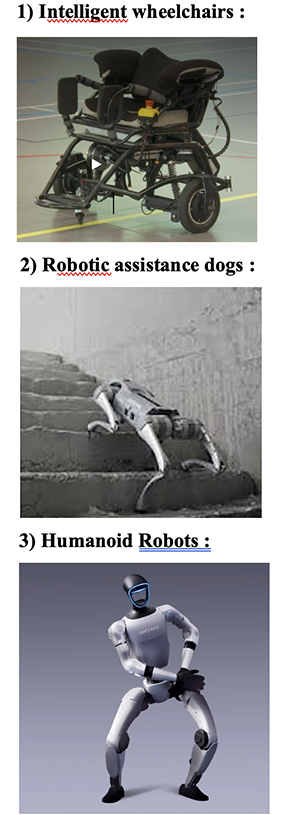
3 Axes of competition proposed
The Volting Cup competition operationalizes this concept through three complementary experimental axes :
Volting Cup brings together researchers, engineers, artists, clinicians, rehabilitation specialists, and disabled performers to foster innovation and social inclusion through creative experimentation. By combining artistic expression with advanced robotics research, the project highlights the importance of co-adaptation, emotional interaction, and socially intelligible robotic behavior.
Hosted within IROS 2026, Volting Cup positions robotics as a human-centered discipline dedicated to accessibility, collaboration, and societal benefit, while strengthening international cooperation and interdisciplinary research.
The jury members for The Volting Cup at IROS 2026 :
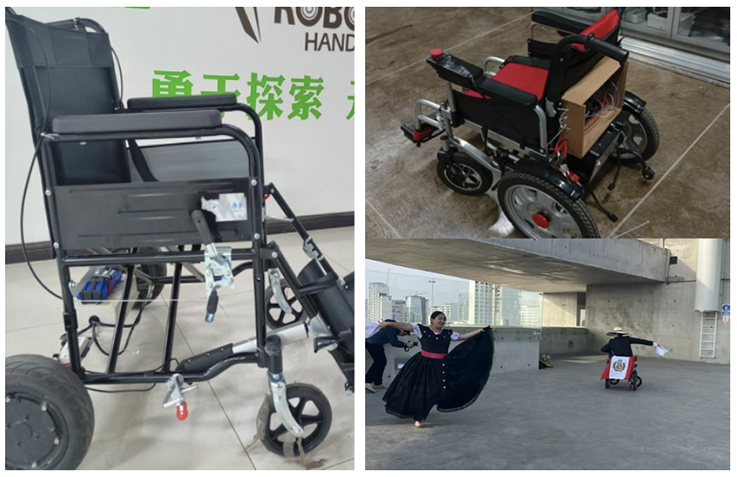 Axe 1 - Intelligent wheelchairs :
Intelligent wheelchairs integrates mobility assistance challenges, including:
platform for human assistance robotics, spanning artistic interaction and daily-life support.
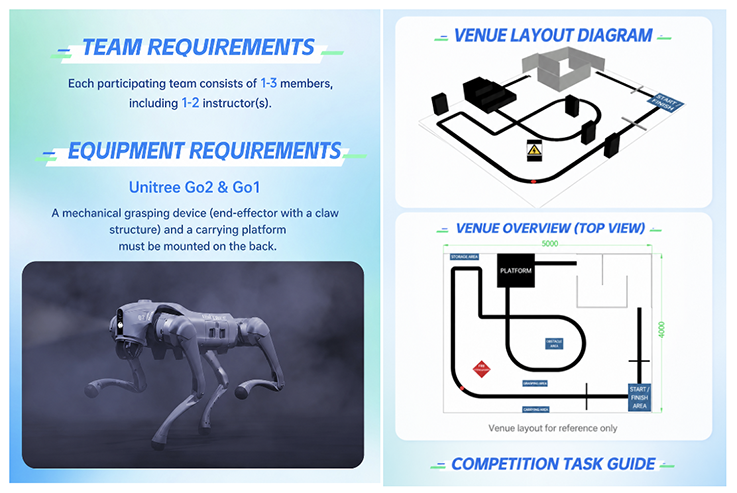 Axe 2 : Robotics Assistance Dogs
Unitree Technology – Official partner of the competition
Thanks to their excellent mobility and ability to adapt to their environment, quadruped robots have gradually emerged as a new generation of intelligent inspection solutions to assist in sectors such as guidance.
Compared to traditional manual inspection methods, these robots offer greater adaptability to complex environments. They can operate continuously 24 hours a day, 7 days a week, whilst ensuring high-precision data collection and excellent stability.
They thus effectively reduce operational safety risks, improve the efficiency of inspection missions and lower overall operating and maintenance costs.
This competition aims to enable participants to understand and master the use of quadruped robots in inspection scenarios, whilst contributing to the training of new talent for the sector’s development.
Axe 3 : Humanoid Robot Challenge Based on Household Scenarios
I. Competition Overview
This competition centers on the theme of robotic home care. Entering household environments represents the ultimate application scenario for future robots, where tasks are diverse and non-standardized. Robots are required to utilize various human-like perception systems and hardware bodies to accomplish complex missions.
The event invites teams from global universities, research institutions and innovative groups to submit solutions featuring both technical innovation and practical household deployment value. Entries must complete assigned tasks within a simulated home environment, comprehensively evaluating the robot’s perception capabilities, motion control, human-machine interaction and system stability.
During the competition, participants may operate robots via teleoperation or fully autonomous modes. Judging metrics include task completion quality, data collection speed, and the ability to derive new strategies from collected data.
II. Competition Equipment & Control Modes
Competition Hardware
Unitree G1 & R1 Humanoid Robots
Control Modes
1. Remote Teleoperation
Participants observe the competition field solely through the robot’s native perception hardware, with operation via VR headsets or inertial motion capture suits.
2. Full Autonomy
The robot executes all behaviors independently with zero manual intervention throughout the mission.
 III. Competition Tasks
Participants must rely exclusively on the robot’s onboard perception systems to acquire environmental information and execute sophisticated whole-body coordinated movements, including dual-arm collaboration and full-body motion control.
Official Task: Household Object Sorting
Task Description
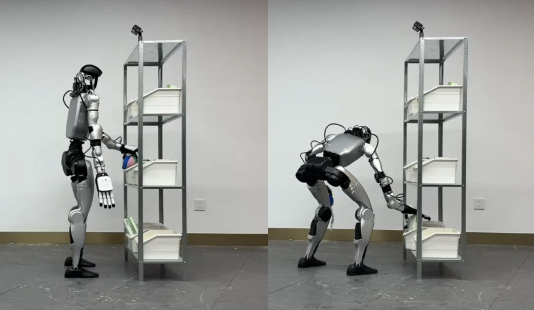
This challenge simulates real-world domestic robotic labor. Within a 10-minute time limit, teams must transfer all objects from three storage areas to the unloading table:
Evaluation Criteria
1. Time Efficiency
2. Execution Quality
IV. Scoring Rules
A successful transfer is defined as retrieving an object from a shelf and placing it stably on the unloading table within the 10-minute competition window.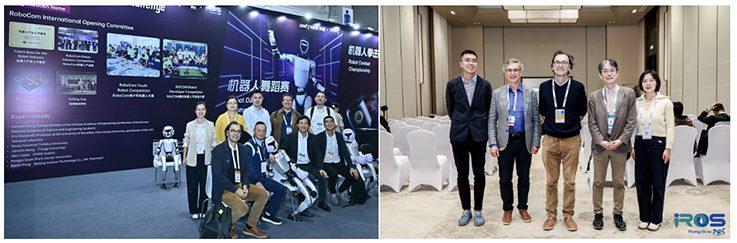
Jury IROS 2025

3 Axes of competition proposed
The Volting Cup competition operationalizes this concept through three complementary experimental axes :
- Intelligent wheelchairs
- Robotic assistance dogs
- Humanoid Robot Challenge Based on Household Scenarios
Volting Cup brings together researchers, engineers, artists, clinicians, rehabilitation specialists, and disabled performers to foster innovation and social inclusion through creative experimentation. By combining artistic expression with advanced robotics research, the project highlights the importance of co-adaptation, emotional interaction, and socially intelligible robotic behavior.
Hosted within IROS 2026, Volting Cup positions robotics as a human-centered discipline dedicated to accessibility, collaboration, and societal benefit, while strengthening international cooperation and interdisciplinary research.
The jury members for The Volting Cup at IROS 2026 :
- Eric Monacelli, Coordinator, Professor at the University of Versailles, Paris-Saclay University.
- Jianwei Zhang, Foreign Member of the Chinese Academy of Engineering, Member of the National Academy of Science and Engineering (Germany).
- Yasuhisa Hirata, Professor, Graduate School of Engineering, Tohoku University, Chair of the IEEE RAS Technical Committee Cluster on Healthcare and Medical Robotics.
- Fabio Bonsignorio, Professor, ERA Chair in AI for Robotics, University of Zagreb Faculty of Eletrical Engineering and Computing, CEO and Founder Heron Robots, co-chairing the IEEE RAS Technical Committee on Performance and Benchmarking, coordinator of euRobotics aisbl Topic Group on Benchmarking and Competions.
- Jianmin Wang, Professor and Doctoral Supervisor of College of Arts and Media, Tongji University.
- Hongyu Guan, Research engineer at the University of Versailles, Paris-Saclay University.
- Dr. Baolin Peng, Director of Guoxin Embodied Intelligence Innovation Center, Chairman of RoboCom International Opening Committee, Deputy Director of the Artificial Intelligence Ethics Governance Laboratory at Beijing Normal University, Adjunct Professor, Ph.D. Supervisor in Arts, Krirk University, Thailand.
- Bin Gong,Secretary-General of Guoxin Embodied Intelligence Innovation Center,Secretary-General of RoboCom International Opening Committee.
- Binghao Wu, Head of Industry-Education Integration, Unitree Technology Co., Ltd.
Axe 1 - Intelligent wheelchairs :Intelligent wheelchairs integrates mobility assistance challenges, including:
- Robotic wheelchairs
- Intelligent walkers
- Exoskeletons
- Smart wearable systems
- Safe navigation
- Adaptive assistance
- User-centered control
- Ergonomics and accessibility
- AI-assisted decision support
platform for human assistance robotics, spanning artistic interaction and daily-life support.
Axe 2 : Robotics Assistance DogsUnitree Technology – Official partner of the competition
Thanks to their excellent mobility and ability to adapt to their environment, quadruped robots have gradually emerged as a new generation of intelligent inspection solutions to assist in sectors such as guidance.
Compared to traditional manual inspection methods, these robots offer greater adaptability to complex environments. They can operate continuously 24 hours a day, 7 days a week, whilst ensuring high-precision data collection and excellent stability.
They thus effectively reduce operational safety risks, improve the efficiency of inspection missions and lower overall operating and maintenance costs.
This competition aims to enable participants to understand and master the use of quadruped robots in inspection scenarios, whilst contributing to the training of new talent for the sector’s development.
Axe 3 : Humanoid Robot Challenge Based on Household Scenarios
I. Competition Overview
This competition centers on the theme of robotic home care. Entering household environments represents the ultimate application scenario for future robots, where tasks are diverse and non-standardized. Robots are required to utilize various human-like perception systems and hardware bodies to accomplish complex missions.
The event invites teams from global universities, research institutions and innovative groups to submit solutions featuring both technical innovation and practical household deployment value. Entries must complete assigned tasks within a simulated home environment, comprehensively evaluating the robot’s perception capabilities, motion control, human-machine interaction and system stability.
During the competition, participants may operate robots via teleoperation or fully autonomous modes. Judging metrics include task completion quality, data collection speed, and the ability to derive new strategies from collected data.
II. Competition Equipment & Control Modes
Competition Hardware
Unitree G1 & R1 Humanoid Robots
Control Modes
1. Remote Teleoperation
Participants observe the competition field solely through the robot’s native perception hardware, with operation via VR headsets or inertial motion capture suits.
2. Full Autonomy
The robot executes all behaviors independently with zero manual intervention throughout the mission.
III. Competition TasksParticipants must rely exclusively on the robot’s onboard perception systems to acquire environmental information and execute sophisticated whole-body coordinated movements, including dual-arm collaboration and full-body motion control.
Official Task: Household Object Sorting
Task Description
This challenge simulates real-world domestic robotic labor. Within a 10-minute time limit, teams must transfer all objects from three storage areas to the unloading table:
- High shelf (robot upright posture)
- Mid shelf (robot bending posture)
- Ground-level shelf (robot squatting posture)
Evaluation Criteria
1. Time Efficiency
- Maximize the quantity of successfully transported objects within the allotted time
- Minimize the duration of each single object transfer cycle
2. Execution Quality
- Success rate of grasping objects from shelves
- Number of instances where objects drop mid-transport
IV. Scoring Rules
A successful transfer is defined as retrieving an object from a shelf and placing it stably on the unloading table within the 10-minute competition window.
- +5 points per object successfully transferred from the high shelf
- +8 points per object successfully transferred from the mid shelf
- +10 points per object successfully transferred from the ground-level shelf
- -3 points for every object dropped to the ground during transit
- Champion: €6,000 coupon for G1 Edu Advanced Version
- 1st Runner-Up: €5,000 coupon for G1 Edu Advanced Version
- 2nd Runner-Up: €4,000 coupon for G1 Edu Advanced Version
- 4th–8th Place: €1,000 coupon for G1 Edu Advanced Version
Jury IROS 2025
Informations complémentaires
Contact
Eric Monacelli eric.monacelli@uvsq.fr
> Laboratoire d'Ingénierie des systèmes de Versailles (LISV)
> IROS 2026
Eric Monacelli eric.monacelli@uvsq.fr
> Laboratoire d'Ingénierie des systèmes de Versailles (LISV)
> IROS 2026
Inscriptions
3 axes
Key figures
- 720 faculty
- 500 technical and administrative staff
- 700 PhD students
- 11 Paris-Saclay doctoral schools
- 2 regional doctoral schools and one Franco-German doctoral college (Myograd)
- 1 Vision Institute
- 1 simulation laboratory
38 research centers and units:
- 17 UVSQ-specific research teams
- 13 joint research units with major research organizations
- 2 joint service units
- 4 research federations
- 1 center for clinical investigation and technological innovation
- 1 astronomical observatory